
The role of immigration in building a talent hub

Just how strategic is global mobility? Is immigration a transaction service for business, or does immigration play a more pivotal role in nurturing talent?
I talk to many mobility professionals who profess to wanting to push global mobility into a more strategic space for their business. However, I also speak with many executives who see global mobility more as an enabler for their business rather than part of their strategic direction.
It makes no sense to me that there is such an overwhelming focus on the compliance aspects of moving talent globally, when in 2020 in excess of 90% of work permit applications lodged with the local authorities are approved.
When was the last time you had a conversation centred on the strategic role which immigration plays in supporting talent and delivering a competitive advantage to your business?
Immigration is long overdue to be disrupted. We are now seeing signs of immigration being disrupted, which I predict will see a fundamental shift in how companies use immigration as a strategic enabler for their business.
I have often stated that immigration has become a tool to attract, retain and incentivise talent.
Access to global talent plays a vital role in the success of any economy, especially one with knowledge gaps and an ageing population. The most valuable companies rely on a diverse and open pool of workers. It’s this access which gives them a strategic advantage over competition. A highly desired locality will play a role in attracting individuals at the top of their profession.
Defining Global Talent
The Committee for Sydney in its 2018 report titled "Making the most of our talent: Sydney as a Global Hub", defined global talent in the following way.
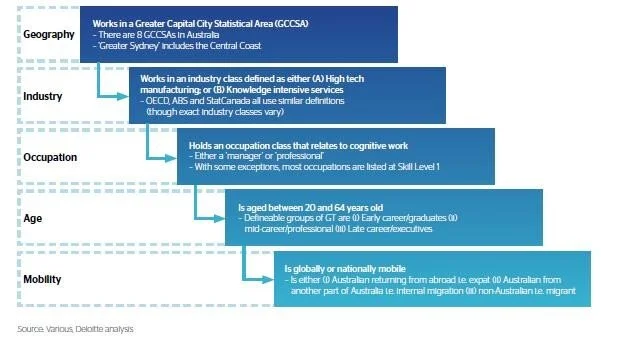
Global talent hubs play an incredibly important role for virtually every company which operates on a global scale. The benefits of attracting global talent include:
Attract capital, investment and other global talent workers
Innovation and entrepreneurship
Filling skills gaps
Diffusion of knowledge
Productivity and job creation
Global Talent Competitiveness Index
The Global Talent Competitiveness Index (GTCI) is an annual benchmarking report that measures and ranks countries based on their ability to grow, attract and retain talent.
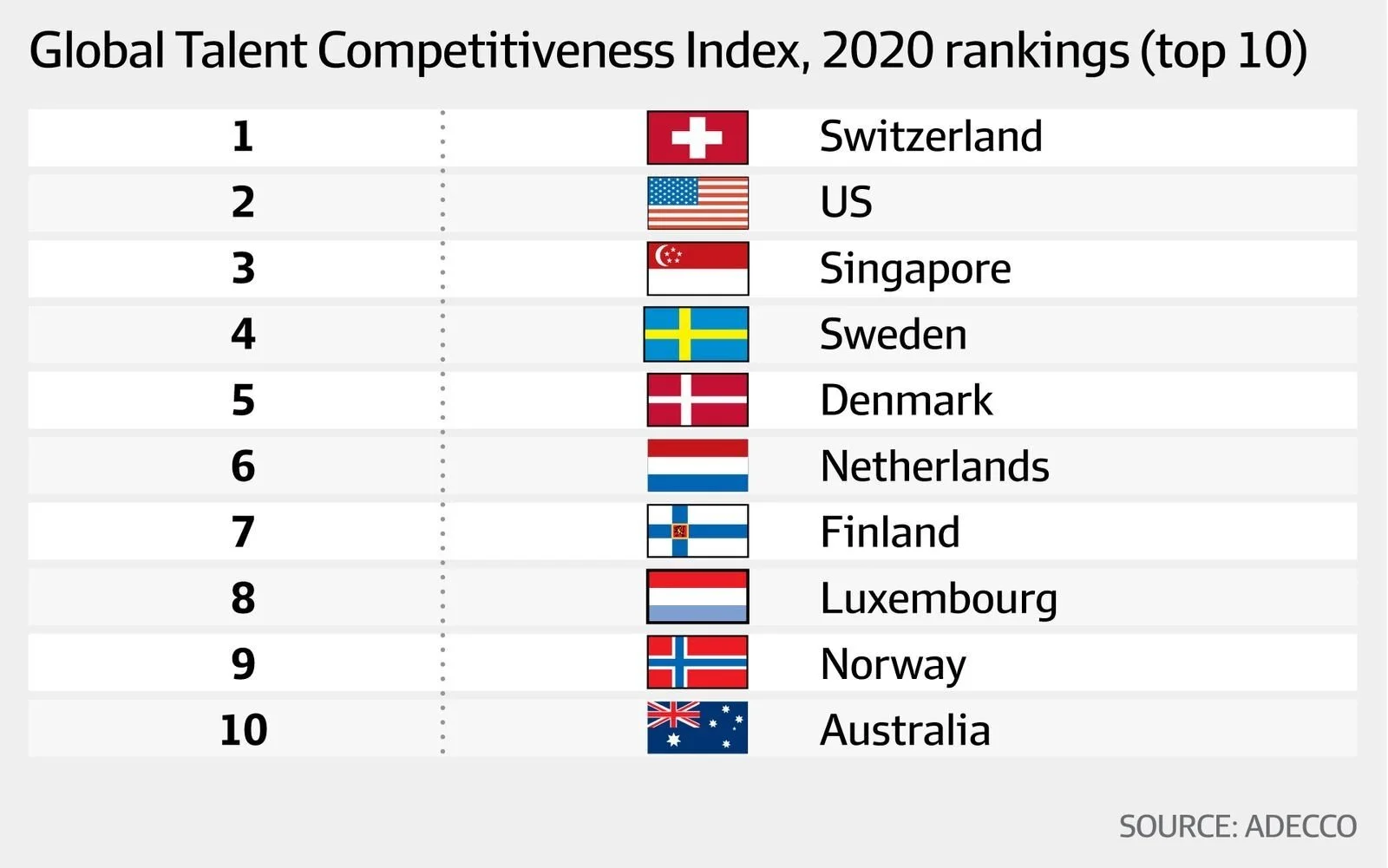
The GTCI combines the academic research and expertise of INSEAD, the international business school, with the business experience and perspective of The Adecco Group and Google.
Launched for the first time in 2014, the GTCI provides a wealth of data and analysis that helps decision makers develop talent strategies, overcome talent mismatches and become more competitive in the global marketplace.
The 2020 GTCI report ranks two Asia Pacific countries in the top 10 (Singapore #3 and Australia #10). Sydney, Melbourne and Brisbane feature at 11th, 21st and 43rd on the list, with New York, London and Singapore the top three cities for talent competitiveness. Sydney has improved its global talent competitiveness moving from 18th in 2018.
This raises some concerns for companies which are invested in Asia being their future growth engines. It also illustrates a misalignment with Asia being cited as the region with the greatest growth potential for the business community. but in spite of this Asia does not seem equipped to attract the talent necessary to deliver on this growth.
The recent coronavirus outbreak and the consequential impact on Asian economies are likely to have a negative impact on economic growth in the region and also dampen the attractiveness of the region for global talent.
The interplay between immigration and talent
So where does this scenario leave the role immigration and mobility plays in building and nurturing talent?
In fact, this is a tremendous opportunity to re-immagine the role immigration plays within business. Rather than viewing immigration as a compliance driven enabler for business, immigration can become a strategic driver of talent attraction and dvelopment.
Let me be clear - immigration will continue to be valued as a compliance offering for the foreseeable future. Ultimately, business expects visas and work permits to be approved quickly and cost effectively, and for the employee experience to be seamless and positive.
However, more than ever, business also want their talent on demand and for the geopolitical uncertainties around moving talent internationally to be navigated with certainty.
This trend is resulting in business having a more direct dialogue with government in immigration policy design and implementation. It is also resulting in business negotiating tailored labour agreements which are more aligned to their workforce and talent requirements.
Governments are also starting to recognise the pivotal role played by immigration in attracting and nururing talent.
The Australian government last year announced it would establish a new, high-skilled migration stream that will fast-track visas for 5,000 of the world's best and brightest every year with the aim of entrenching high-tech industries in Australia.with the aim of entrenching high-tech industries in Australia.
A real world scenario
So how does all translate to a real world scenario for the business community? The following helps illustrate how a change in focus can benefit the talent discussion.
I recently was invited to assist a global business with securing visas for graduates hired in Asia to be trained in multiple global locations for periods of up to 12 months. The initial brief from the business was very immigration centric. The business was challenged around the complexity and time consuming process of securing the necessary visas for their graduate new hires.
A wider discussion with the business highlighted that this was in fact much more than an immigration challenge. The company was investing heavily in an Asian talent hub for its business, and the graduate new hires were a significant investment in the future of the business in the region.
The discussion evolved into a project centred on helping the business design and implement a global intern program which could be deployed in multiple strategically important hub locations for the business. The project became a workforce management and talent development initiative with immigration assistance being a small, but important element of the project.
The wider lens we brought to the discussion with the business maximised the benefit of the investment the company was making in its global intern program, and ensured that the highly valued talent the company was recruiting to the business was receiving best-in-class employee experience which in turn maximised retention rates.
Final Thoughts
The future of work has fundamentally reshaped the pivotal role which immigration plays in attracting and nurturing talent. In an increasingly connected global marketplace, business will continue to invest in building talent hubs in targeted locations to help drive growth and open new opportunities.
It's important that immigration and mobility be integrated into the wider talent management program of business, and that the performance of the talent management framework be regularly reviewed and revised as market forces change.